Recent and current projects. Search the archives for old projects.
February 2011
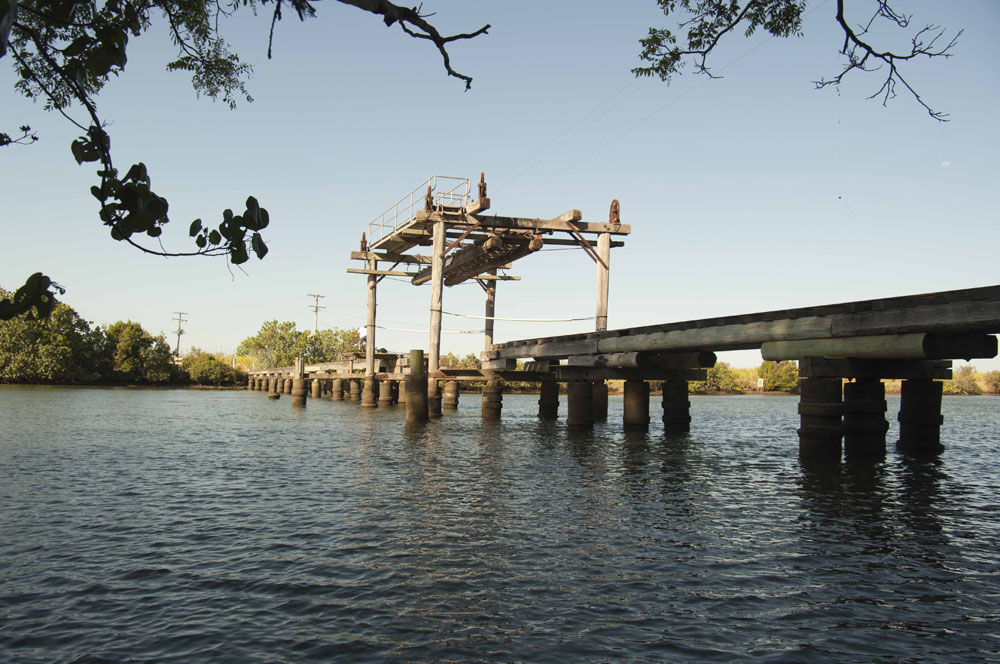
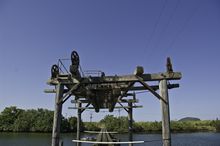
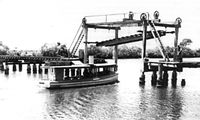
The Maroochy River Lift bridge was erected in 1921 by the Moreton Central Mill company. It was built as part of the expansion of the tram network in the district and was catalyst for the expansion of the industry on the northern side of the Maroochy River.
The bridge was decommissioned in 2003 with the closure of the Moreton Central Mill.
The Maroochy River lift bridge is the only example of this type of bridge in Queensland. Lift bridges were a form of moveable bridge that allowed the construction of a low level bridge while permitting the movement of vessels. Lift bridges were not common in Australia and were only built where it was necessary to provide clearance for vessels. In Queensland , most rail and road bridges were built over waterways that were not used by vessels requiring clearance. High level bridges were normally built when clearance was required. Lift bridge were only suitable and feasible in a situation such as on the Maroochy River that did not carry a large volume of watercraft.
location
October 2006

This survey focused on recording the remains of the former Petrie Terrace Gaol which was built in 1860. The survey and recording was undertaken in September- October 2006.
The gaol closed in 1883 and the site became a Police Depot. The cell blocks and walls were demolished but the kitchen and gatehouses continued to be used by the Police Department. These buildings were eventually demolished in 1940. Since the 1880s, the Police Department erected various buildings on the site, including a substantial brick building in 1938. The site was sold in 1987.
More images
location
July 2006
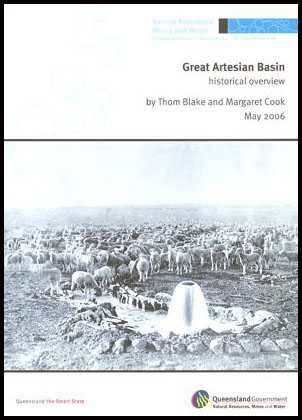
This history was commissioned by the Department of Natural Resources and Mines. It was to complement a range of studies prepared to assists in the development of the Great Artesian Basin Water Resource Plan. Margaret Cook was the co-author on the project.
Surprisingly, little research has been undertaken on the history of the GAB, at least from a social and cultural perspective. This history explores some of the more significant impacts of the use for of the Great Artesian Basin, particularly in relation to the development of the pastoral industry, stock routes, railway and towns in western Queensland.
May 2006

Targinnie is a small rural community north-west of Gladstone. Its history is not unlike many other rural areas of Queensland – Indigenous occupation, pastoralism, agriculture, timber and some mining.
May 2006
Bladensburg National Park is located 20 km south of Winton. It comprises more than 84 000 ha and was formed as a result of the acquisition of Bladensburg Station in 1983 and 1993.
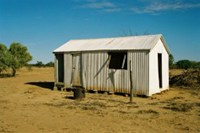
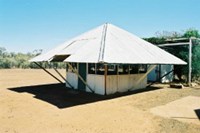
The homestead and shearing quarters remain. This conservation plan was to provide advice on conserving the homestead and shearing quarters.
May 2004
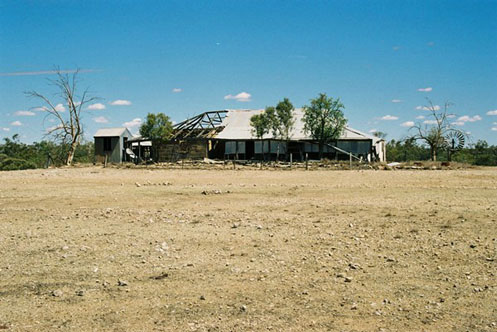
Old Cork homestead is located 150 southwest of Winton on the Diamantina River. The homestead was built of sandstone in the early 1880s when Cork Station was partly owned by Thomas McIlwraith, the then premier of Queensland. The house is now partly a ruin, having been abandoned about 30 years ago.
See location
More images
Download
Old Cork Homestead Conservation Plan
April 2004
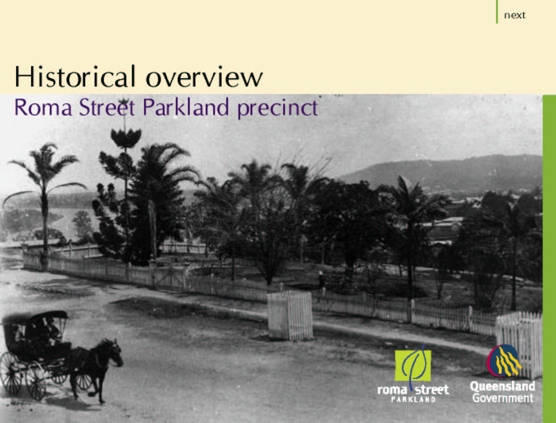
This historical overview was commissioned in 2002 by the Queensland government to provide a historical context for the recently opened Roma Street Parklands. The overview was published only as a PDF document available online.
Download
Historical overview Roma Street Parkland precinct
May 1996
This survey was commissioned by Queensland Health to assess the heritage significance of all their sites. It was at the time the most comprehensive assessment of health buildings in Queensland.
By comprehensively assessing all sites, comparative analysis was possible for a range of building types including maternity hospitals.